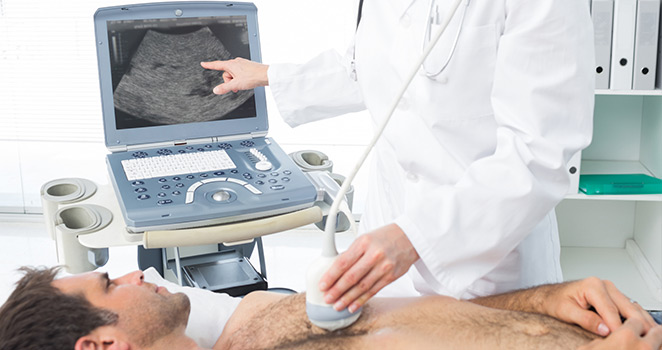
Endoscopic Ultrasound (EUS) is an advanced endoscopic procedure that combines endoscopy with ultrasound imaging. A specialised endoscope with an ultrasound probe at its tip is used to obtain detailed images of the digestive tract wall and surrounding organs, including the pancreas, bile duct, and lymph nodes.
EUS is performed to:
For upper EUS: nothing to eat for 6 hours, nothing to drink for 2 hours before the procedure.
For lower EUS (rectal): bowel preparation may be required.
Please inform your doctor about all medications you are taking, particularly blood thinners, as these may need to be stopped before the procedure.
The procedure is performed under sedation. The echoendoscope is passed through the mouth (for upper EUS) or through the rectum (for lower EUS). The ultrasound probe generates high-frequency sound waves that create detailed images of the digestive tract wall and adjacent structures.
If a suspicious lesion is identified, a fine needle can be passed through the endoscope to obtain tissue samples (fine needle aspiration or biopsy). This is performed under real-time ultrasound guidance.
The procedure typically takes 30 to 60 minutes.
Recovery is similar to a standard endoscopy. You will be monitored until the sedation wears off.
Your doctor will discuss preliminary findings with you on the day. If tissue samples were taken, final results may take several days.
Because of the sedation given it is very important that you do not drive a car, travel on public transport alone, operate machinery, sign legal documents or drink alcohol on the same day after the test. It is strongly advised that a friend or relative take you home and stay with you.
EUS is generally a safe procedure. Risks are similar to standard endoscopy and include:
If you have any of the following symptoms in the hours or days after EUS
Please contact your doctor or present to the nearest emergency department immediately.